✨ This article was AI edited. Editorial responsibility: SelfDefenseGuides.info.
Produced with AI. This article was artificially generated. Editorial responsibility: SelfDefenseGuides.info.
What are weapons in self-defense? In statutory jurisprudence and personal protection doctrine, a self-defense weapon is any instrument, device, or improvised object—ranging from non-lethal pepper spray and conducted energy devices to edged tools and firearms—utilized by an individual to repel an imminent unlawful physical assault and preserve bodily integrity.
When individuals consider personal security, the conversation frequently turns to defensive armament. However, what legally and tactically constitutes a “weapon” extends far beyond conventional firearms or combat knives. The classification of defensive tools encompasses a spectrum ranging from purpose-built commercial defensive technologies to common everyday objects adapted for emergency protection.
Navigating the selection and deployment of defensive weapons requires understanding two interdependent domains: tactical efficacy (how well the tool stops an assault) and legal liability (how the law evaluates the proportionality and justification of the force applied). This comprehensive guide examines the primary categories of defensive weapons, their operational mechanics, legal classifications, and deployment principles.
Defensive Weapon Hierarchy and Force Spectrum Matrix
Defensive tools are organized along the standard law enforcement use-of-force continuum. The following comparative matrix outlines the primary categories of defensive weapons, their operational reach, physiological stopping mechanisms, and legal risk profiles:
| Weapon Category | Primary Examples | Effective Engagement Distance | Physiological Mechanism | Force Classification | Legal Risk / Burden of Proof |
|---|---|---|---|---|---|
| Deterrents & Acoustic Tools | Personal alarms, high-candela strobe flashlights | 10 to 50+ feet | Sensory disorientation, auditory shock, attention drawing | Non-Force / Passive | Zero legal liability; unrestricted carry |
| Chemical Aerosols | OC Pepper Spray, CS tear gas, pepper gel | 6 to 15 feet | Inflammatory irritation of mucous membranes, involuntary eye closure | Less-Lethal / Intermediate | Low liability; broad statutory defense justification |
| Conducted Energy Devices (CEDs) | Taser pulse devices, contact stun guns | Contact to 15 feet (probes) | Neuromuscular incapacitation (NMI) vs. localized pain compliance | Less-Lethal / Compliance | Moderate; subject to local permit and carry regulations |
| Impact & Striking Weapons | Expandable batons, kubotans, tactical saps, heavy canes | Contact to 3 feet | Kinetic energy transfer, bone/muscle contusion, motor dysfunction | Intermediate to Lethal (head/neck) | High; strict statutory bans on concealed batons and saps |
| Edged & Pointed Weapons | Tactical folding knives, fixed push daggers | Close contact (grappling range) | Laceration, structural tendon severance, hypovolemic shock | Lethal / Deadly Force | Extreme; treated under homicide statutes if fatal |
| Firearms & Projectiles | Concealed carry handguns, defensive shotguns | Point-blank to 25+ yards | Hydrostatic shock, cavitation, instantaneous central nervous system destruction | Lethal / Deadly Force | Highest; requires articulable fear of death or great bodily harm |
| Improvised Everyday Objects | Steel tactical pens, heavy umbrellas, weighted padlocks, flashlights | Variable contact | Reinforced striking surface, concentrated point pressure | Context-Dependent | Favorable legal posture when pre-intent is absent |
Category 1: Non-Lethal & Chemical Defensive Tools
Non-lethal weapons are engineered to incapacitate an assailant without inflicting permanent anatomical trauma, organ failure, or death. In civilian self-defense, they offer a vital middle ground between unarmed evasion and deadly force.
1. Oleoresin Capsicum (OC) Pepper Spray & Gels
Extracted from natural chili peppers, Oleoresin Capsicum (OC) is an intense inflammatory agent that acts immediately upon contact with skin, eyes, and respiratory passages:
- Ocular Effect: Dilates capillary vessels, triggering acute blepharospasm (involuntary, forceful closing of the eyelids). The attacker is effectively blinded for 20 to 45 minutes.
- Respiratory Effect: Inhaling airborne capsaicin droplets inflames the pulmonary mucous membranes, inducing uncontrollable coughing, shortness of breath, and a psychological sense of suffocation.
- Formulation Comparison: Traditional liquid spray patterns disperse broadly but risk blowback in outdoor headwinds. Pepper gel formulations fire a viscous stream resistant to crosswinds, adhering directly to the assailant’s face while minimizing indoor cross-contamination.
2. Conducted Energy Devices: Tasers vs. Stun Guns
Consumers frequently confuse contact stun guns with projectile Taser units, yet their biological stopping power differs fundamentally:
- Contact Stun Guns: Deliver high-voltage, low-amperage electrical current across surface electrodes held against an attacker’s body. They rely purely on pain compliance. Against an aggressive assailant saturated with adrenaline or narcotics, contact stun guns frequently fail to halt forward momentum.
- Taser Pulse Weapons: Launch two dart probes trailing insulated wires up to 15 feet. By creating an electrical circuit that penetrates clothing into muscle tissue, the device introduces shaped electrical pulses that override the central nervous system, causing true Neuromuscular Incapacitation (NMI). The attacker’s skeletal muscles seize, causing an instantaneous, involuntary physical collapse.
Category 2: Impact Weapons and Kinetic Multipliers
Impact weapons amplify the natural striking force of the human hand, concentrating kinetic energy onto small surface areas to break bones or deaden nerve centers.
1. Expandable Friction-Lock Batons
Developed for law enforcement patrol, expandable steel batons deploy from a compact 8-inch handle to a 21- or 26-inch hardened steel rod with a flick of the wrist. The heavy tip generates massive centrifugal torque, capable of fracturing long bones or producing severe motor dysfunction when directed at the quadriceps or peroneal nerve corridors. However, many state and municipal jurisdictions classify collapsible batons as prohibited dangerous weapons, making concealed carry a misdemeanor or felony offense.
2. Palm Sticks, Kubotans & Tactical Pens
These compact cylindrical tools—typically made of aerospace-grade aluminum or reinforced polymer—extend slightly beyond either side of a closed fist. They serve two tactical functions: reinforcing the structural rigidity of the fist during punch impact, and acting as a hardened focal point for targeting soft tissue, the solar plexus, or cranial angles during close-quarters grappling.
Category 3: Deadly Force Implements (Edged Weapons and Firearms)
When an attacker displays the capability, opportunity, and intent to inflict death or severe permanent bodily harm, the law recognizes the justification of deadly force.
1. The Reality of Defensive Knives
While defensive folding knives are easily carried, deploying a blade in self-defense carries immense biological and legal challenges. Edged weapons do not possess instantaneous stopping power unless they sever the brainstem or cervical spinal cord; an attacker sustaining fatal vascular lacerations can continue violent action for 30 to 60 seconds before hypovolemic shock (blood loss) induces unconsciousness. Furthermore, in courtroom presentations, knife wounds often appear graphic and aggressive to juries, placing a heavier burden on the defense to prove absolute necessity.
2. Defensive Firearms
A firearm is the definitive deadly force tool, offering the highest level of physiological stopping power at stand-off distances. Deploying a firearm requires rigorous training in marksmanship, weapon retention, situational awareness, and split-second legal decision-making. In every jurisdiction, drawing or discharging a firearm is legally classified as lethal force, regardless of whether a projectile strikes the assailant.
Improvised Weapons in Emergency Encounters
An improvised weapon is any non-traditional object adapted in the moment of crisis to defend against violence:
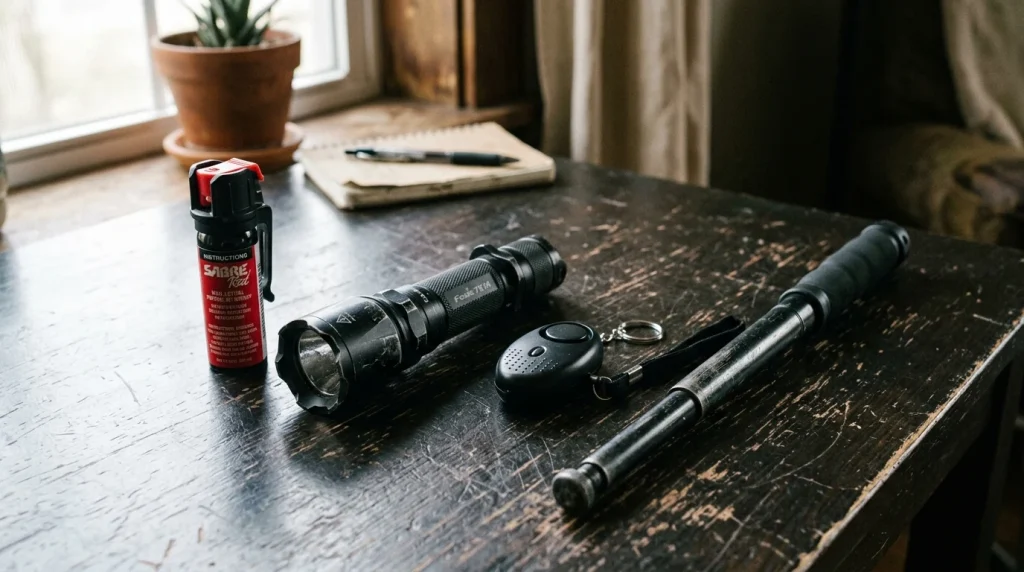
- Tactical LED Flashlights: A high-output flashlight (1,000+ lumens) with a crenellated strike bezel provides double-duty utility: disorienting an attacker’s night vision with sudden photon burst while offering a durable impact weapon for striking.
- Heavy Umbrellas & Walking Canes: Functional walking sticks and sturdy umbrellas represent non-threatening, universally legal impact tools capable of maintaining stand-off distance and blocking incoming weapon strikes.
- Weighted Ropes & Padlocks: Common hardware tools adapted for swinging leverage in extreme survival scenarios.
Legal Constraints and The Proportionality Doctrine
Carrying and using a weapon in self-defense is strictly governed by the statutory law of the jurisdiction in which the confrontation occurs. The application of defensive force must satisfy three foundational legal requirements:
- Ability / Capability: The assailant must possess the physical power or weapon necessary to inflict bodily injury.
- Opportunity: The assailant must be in a position and within physical distance to deploy that capability immediately.
- Jeopardy / Imminent Intent: The assailant’s overt actions or spoken words must communicate an active, unmistakable intent to cause harm.
Crucially, the force applied must remain proportional. Deploying a deadly weapon (such as a firearm or combat knife) against a minor unarmed push or verbal insult constitutes unlawful aggravated assault or manslaughter. The defender must articulate why the specific level of force was objectively reasonable under the totality of the circumstances.
Frequently Asked Questions
Is pepper spray considered a deadly weapon under the law?
No. In virtually all jurisdictions, Oleoresin Capsicum (OC) pepper spray is legally classified as a non-lethal or less-lethal intermediate defensive tool. Because it does not inflict permanent structural damage, organ failure, or death, using pepper spray to escape an unlawful assault carries a minimal risk of criminal liability.
Can everyday objects be legally classified as weapons?
Yes. Under the legal doctrine of “dangerous instruments,” courts evaluate objects based on how they were used rather than their original manufacturing purpose. A pen, baseball bat, or heavy flashlight used to inflict intentional bodily injury will be legally categorized as a weapon during criminal proceedings.
Are stun guns and Tasers legal in all states?
While Supreme Court rulings (such as Caetano v. Massachusetts) have extended Second Amendment protections to electronic stun weapons, several states and municipalities maintain licensing requirements, age restrictions, or concealed carry bans. Always check municipal and state statutes before purchasing or carrying electronic weapons.
What should you do immediately after using a weapon in self-defense?
Disengage safely from the threat, retreat to a secure location, and immediately dial emergency services (911). Clearly identify yourself as the victim who was attacked, report your location, request medical assistance for any injured parties, and request police intervention. When officers arrive, keep your hands visible, comply with all verbal commands, and provide a basic factual summary while reserving detailed interrogation until you have legal counsel present.
Get our latest guides, news, and insights highlighted in your Google Search & AI Overviews.