
✨ This article was AI edited. Editorial responsibility: SelfDefenseGuides.info.
Produced with AI. This article was artificially generated. Editorial responsibility: SelfDefenseGuides.info.
For more than a century, law enforcement officers and defensive practitioners have relied on impact weapons to bridge the critical gap between empty-hand physical restraint and lethal firearms discharge. Yet the tools chosen to deliver intermediate impact force have undergone radical technological and doctrinal shifts.
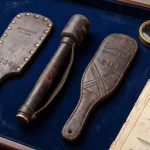
From the mid-19th century through the late 1970s, police officers frequently carried weighted leather slapjacks alongside or in place of traditional wooden clubs—often referring to them in regional vernacular as a slapjack baton. Today, law enforcement arsenals have universally replaced weighted leather saps with expandable steel friction-lock batons (such as those manufactured by ASP and Monadnock). In this technical comparison, we examine the mechanical construction, kinetic ballistics, medical trauma liabilities, and statutory legal status separating historical slapjacks from modern tactical police batons.
Mechanical Architecture: Flexible Whip vs. Rigid Lever
The operational divide between a slapjack and a modern expandable police baton stems from fundamentally different physical principles:
- The Slapjack (Flexible Kinetic Multiplier): A slapjack consists of a flat lead weight or lead shot pouch encased in stitched heavy leather, supported by a flat spring-steel shank running through the grip. The weapon measures between 7 and 11 inches in overall length. It operates as a flexible compound pendulum: during deceleration, the spring flexes forward, whipping the lead head into the target at terminal speeds exceeding the speed of the officer’s arm.
- The Expandable Police Baton (Rigid Centrifugal Lever): Fabricated from 4140 high-carbon seamless alloy steel tubing, an expandable baton collapses to approximately 8 to 10 inches and expands to 21 or 26 inches via friction-lock or mechanical push-button detents. It operates as a rigid third-class lever, multiplying rotational velocity at the solid steel tip through sheer arc radius.
Direct Comparison Matrix: Slapjack vs. Tactical Batons
| Feature | Slapjack / Flat Sap | Straight Wooden Truncheon | Modern Expandable Steel Baton |
|---|---|---|---|
| Primary Material | Vegetable-tanned leather, spring steel, lead | Dense Hickory, Ash, or Cocobolo hardwood | 4140 hardened seamless alloy steel |
| Extended Reach | 7 – 11 inches (Ultra-close range) | 24 – 26 inches (Intermediate standoff) | 21 – 26 inches (Intermediate standoff) |
| Impact Dynamics | High kinetic momentum; spring whip snap | Rigid mass transfer; high recoil shock | Focal tip velocity; shockwave dissipation |
| Legal Carry Status | Banned per se in CA, NY, MA; legal in TX | Regulated as a club / billy | Legal with CCW / security permits in most states |
Why Law Enforcement Replaced Slapjacks with Expandable Batons
The transition away from leather saps and slapjacks was not driven by lack of effectiveness; in fact, saps were retired precisely because they were too destructively effective at close range.
- Uncontrollable Cranial Lethality: Due to their short 8-inch reach, slapjacks could only be deployed when an officer was grappling within arm’s reach of a violent subject. In high-stress wrestling encounters, officers attempting to strike an attacker’s shoulder or clavicle frequently struck the temporal bone or base of the skull, producing fatal epidural hematomas or depressed cranial fractures.
- The Modern Motor Dysfunction Doctrine: Modern police training mandates striking large motor nerve groups (the common peroneal nerve on the outer thigh, femoral nerve on the inner thigh, or radial nerve in the forearm) to induce temporary motor dysfunction without breaking bone. A 21-inch expandable baton allows an officer to maintain safe standoff distance and target leg nerves with precision, whereas a short slapjack encourages dangerous upper-body strikes.
- Civil Liability and Public Perception: In the courtroom, leather blackjacks and saps carry grim historical associations with 1930s mob enforcers and unregulated backroom beatings. Expandable batons, manufactured with uniform industrial finishes and certified training curricula, provide defensible documentation in excessive-force litigation.
Modern Legal Standing for Civilian Self-Defense
For civilians seeking personal defense tools, choosing between a slapjack and an expandable baton involves navigating state weapons statutes:
- State Prohibitions on Saps: States like California (Penal Code § 22210) and New York (Penal Law § 265.01) classify slapjacks, blackjacks, and saps as prohibited offensive weapons alongside brass knuckles. Mere possession in a home or vehicle is prosecuted as a misdemeanor or felony.
- Expandable Batons as Concealed Weapons: In contrast, expandable steel batons are frequently permitted under general concealed carry weapon (CCW) licenses (such as in Florida, Nevada, and Utah) or treated as ordinary non-lethal defensive tools (subject to general club laws).
For a detailed state-by-state statutory breakdown, explore our state self-defense laws map and our legal analysis of personal defense impact implements.
Frequently Asked Questions: Slapjack Batons
Do any police departments still authorize slapjacks?
Virtually no mainstream American law enforcement agency permits slapjacks today. Departmental force continuums require certified expandable batons, chemical sprays, or conducted electrical weapons (TASERs).
Which delivers more force: an ASP baton or a slapjack?
An expandable steel baton generates higher kinetic tip energy due to its 26-inch rotational leverage, but a slapjack transfers heavy concussive mass more efficiently in confined spaces where swinging a full-length baton is impossible.
Is a slapjack considered deadly force in court?
Yes. Any strike to the head, neck, spine, or throat with a lead-weighted slapjack is legally classified as deadly physical force, requiring reasonable fear of imminent death or severe bodily injury to justify.
Can I legally own a collectible vintage slapjack?
In states such as Texas, Arizona, and Florida, collectors can freely own antique slapjacks. In states like California and New York, statutory bans prohibit possession without exceptions for antique collectors.
Get our latest guides, news, and insights highlighted in your Google Search & AI Overviews.