✨ This article was AI edited. Editorial responsibility: SelfDefenseGuides.info.
Produced with AI. This article was artificially generated. Editorial responsibility: SelfDefenseGuides.info.
Walking into a gun store or researching defensive firearms online can be an intimidating experience. With wall-to-wall display cases housing hundreds of polymer-framed striker-fired pistols, classic steel revolvers, tactical carbines, and combat shotguns, prospective gun owners frequently ask the foundational question: what makes a good self defense gun?
A defensive firearm is not a recreational sporting rifle or a weekend range curiosity. It is an emergency life-safety tool that must perform flawlessly during the most terrifying moments of your life—under acute adrenaline dump, compromised fine motor coordination, and low-light environments. In this objective, comprehensive buyer’s guide, we break down the five defining criteria of a reliable defensive weapon, rank the premier handguns across different experience levels, and provide actionable purchasing advice backed by forensic data.
The 5 Non-Negotiable Benchmarks of a Good Defensive Firearm
Before examining specific firearm brands or price tags, evaluate any candidate platform against these five tactical benchmarks:
- Uncompromising Feed & Ignition Reliability: A defensive gun must cycle at least 500 rounds of standard Full Metal Jacket (FMJ) ammunition and 200 rounds of premium Jacketed Hollow Point (JHP) defensive ammunition without a single mechanical stoppage or failure to extract. If a gun is picky with ammo, it is disqualified from defensive duty.
- Passive Internal Drop Safeties: Modern defensive handguns should feature internal drop safeties (firing pin blocks and trigger-shoe safeties) that make accidental discharges physically impossible unless the trigger shoe is deliberately depressed by human finger pressure. Avoid archaic designs prone to discharge when dropped on hard concrete.
- Manageable Recoil Dynamics: Self-defense is not about delivering one massive cinematic blast; it is about rapid, combat-effective shot placement. A cartridge that generates excessive recoil or muzzle blast induces flinching, degrading hit probability when split-second accuracy is paramount.
- Intuitive Sight Picture & Optic Readiness: Over 70% of violent confrontations unfold in low-light or degraded ambient illumination. A good defensive firearm should come equipped with high-visibility tritium night sights or an optic-ready slide cut engineered to mount a micro red dot sight (RDS).
- Widespread Holster & Magazine Availability: A gun you cannot safely holster in rigid Kydex or find factory spare magazines for is an operational liability. Stick to proven platforms supported by reputable holster makers.
Top Rated Self Defense Guns Ranked by Category
The matrix below outlines the top defensive firearms currently setting industry standards for reliability, capacity, and ergonomic versatility:
| Model | Caliber | Capacity | Action | Optimal Defender Profile |
|---|---|---|---|---|
| Glock 19 Gen 5 | 9mm Luger | 15+1 | Striker-Fired | Best Overall: Beginner to Professional |
| SIG Sauer P365 / P365X | 9mm Luger | 10+1 / 12+1 | Striker-Fired | Best Everyday Concealed Carry (Micro) |
| Smith & Wesson M&P9 Shield Plus | 9mm Luger | 10+1 / 13+1 | Striker-Fired | Best Slim Ergonomics & Grip Texture |
| Ruger Security-9 Compact | 9mm Luger | 10+1 / 15+1 | Internal Hammer | Best Budget Defensive Value |
| Smith & Wesson M&P380 Shield EZ | .380 ACP | 8+1 | Internal Hammer | Best for Recoil-Sensitive / Hand Fatigue |
Why 9mm Luger Remains the Premier Defensive Caliber
While advocates of .45 ACP or .40 S&W frequently claim larger calibers provide superior \”stopping power,\” comprehensive ballistic tests by the FBI Academy and real-world police engagement data have rendered the debate obsolete. Modern 9mm Jacketed Hollow Point (JHP) ammunition—such as Speer Gold Dot 124gr, Federal HST 124gr, or Hornady Critical Defense 115gr—offers decisive tactical advantages:
- FBI Gelatin Compliance: Consistently achieves 14 to 18 inches of penetration in calibrated 10% ballistic gelatin through heavy clothing barriers, with bullet expansion consistently exceeding 0.60 inches.
- Capacity Advantage: A compact 9mm handgun holds 12 to 15 rounds in the same frame size that accommodates only 6 to 8 rounds of .45 ACP. In high-stress defense scenarios where hit ratios average 20% to 30%, magazine capacity saves lives.
- Faster Follow-up Splits: Lower felt recoil allows the shooter to return the front sight to center-mass and break consecutive aimed shots in fractions of a second.
- Economical Practice: 9mm ammunition costs roughly half as much per box as .45 ACP or 10mm, enabling defensive gun owners to afford regular live-fire practice.
For more detailed technical evaluations of ballistic performance across ammunition types, see our breakdowns on 9mm ballistic effectiveness and 10mm defense performance.
Defensive Holster Selection and Safety Principles
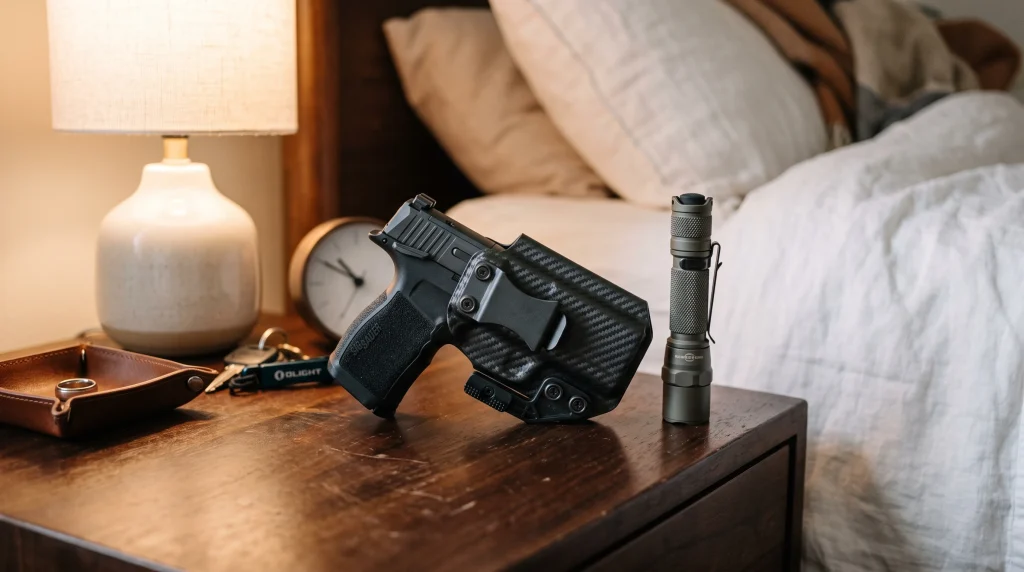
Purchasing a good self defense gun is only half the investment. Carrying a firearm loose in a pocket, purse, or backpack without a dedicated holster invites negligent discharges. A quality defensive holster must possess:
- Molded Rigid Shell: High-grade Kydex or reinforced molded leather that fully encloses the trigger guard, preventing keys, seatbelts, or clothing folds from contacting the trigger.
- Defensive Belt: Pair your holster with a rigid, reinforced everyday carry (EDC) belt designed with internal stiffeners to anchor the holster firmly during drawing.
For state-specific legal requirements regarding concealed and open carry, consult our state self-defense legal directory and our guide on foundational self-defense equipment.
Frequently Asked Questions: Good Self Defense Guns
What is the best overall handgun for self defense?
The Glock 19 (9mm) is widely regarded by law enforcement and tactical instructors as the best all-around defensive handgun, striking a perfect balance between concealability, capacity (15 rounds), and unmatched mechanical reliability.
Are revolvers good self defense guns for beginners?
Revolvers are simple to operate and rarely jam, but their heavy 10-to-12-pound double-action trigger pull, snappy recoil in lightweight snubbies, and limited 5-shot capacity make modern semi-automatics like the Smith & Wesson Shield EZ much easier to shoot accurately.
Do I need an external manual safety on a defensive gun?
Most modern defensive striker-fired handguns rely on internal drop safeties and a trigger-shoe safety rather than a manual thumb lever. In high-stress encounters, forgetting to disengage a manual safety under adrenaline dump can be fatal; a quality rigid holster is your primary safety.
What caliber is easiest to handle for people with arthritis?
The .380 ACP chambered in easy-to-rack platforms like the Smith & Wesson M&P380 Shield EZ or Ruger Security-380 provides manageable slide manipulation and low felt recoil without sacrificing terminal penetration.
Get our latest guides, news, and insights highlighted in your Google Search & AI Overviews.