
✨ This article was AI edited. Editorial responsibility: SelfDefenseGuides.info.
Produced with AI. This article was artificially generated. Editorial responsibility: SelfDefenseGuides.info.
The term cosh (frequently spelled phonetically as kosh) evokes vivid imagery of dark Victorian alleys, 19th-century waterfront press-gangs, and mid-century British underworld syndicates. While modern defensive discussions often center around tactical firearms, high-intensity pepper sprays, and conducted electrical weapons, historical impact implements like the cosh occupy a notorious place in criminal jurisprudence and martial history.
Whether encountered in classic crime literature, historical forensic archives, or modern antique weapon discussions, understanding the mechanical design, terminal kinetic physics, and international legal classifications of the kosh weapon is crucial. In this comprehensive reference guide, we examine the evolution of the cosh from maritime necessity to prohibited offensive weapon, analyzing its construction, striking mechanics, and statutory status across modern legal jurisdictions.
Etymology & Historical Evolution: The Victorian Underworld
The linguistic origin of the word \”cosh\” dates back to early 19th-century British street cant and criminal argot. While some etymologists connect the term to the Romani word kosh or kausht (meaning a stick or wood), the weapon itself emerged from maritime and dockside environments:
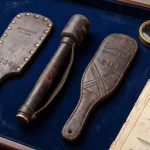
- Press-Gang \”Life Preservers\”: In the 18th and 19th centuries, Royal Navy press-gangs used weighted clubs known ironically as \”life preservers.\” These implements featured a heavy lead ball or whalebone weight attached to a flexible gut or leather shaft, allowing press-gang enforcers to knock out merchant sailors and transport them aboard naval vessels without creating visible, bloody fractures.
- The Victorian Garrotting Panics (1850s–1860s): During mid-Victorian street crime waves in London, street muggers known as \”garrotters\” employed coshes and blackjacks to render victims instantly unconscious from behind. The public outrage prompted Parliament to enact the Security from Violence Act 1863 (the \”Garrotters Act\”), authorizing judicial flogging with the cat-o’-nine-tails for robbery committed with offensive weapons.
- Mid-Century Armed Robbery: From the 1920s through the 1960s, British criminal outfits—including the infamous Kray twins and the Great Train Robbers of 1963—routinely carried lead-weighted coshes during bank raids and warehouse heists as silent, intimidating tools of immediate violence.
Anatomy & Mechanical Construction of a Cosh
Unlike a rigid wooden truncheon or modern friction-lock steel baton, the defining operational characteristic of a genuine cosh is its flexibility. This flexibility produces dynamic kinetic whip, concentrating maximum kinetic energy into the target upon impact.
- The Striking Head: A molded lead weight, steel sphere, or dense pouch of lead shot weighing between 6 and 14 ounces. Lead is favored due to its extreme density (~11.34 g/cm³), allowing significant mass to be concentrated in an ultra-compact silhouette.
- The Flexible Shaft: Constructed from tightly wound helical steel spring, layers of braided rawhide, vulcanized rubber hose, or whalebone. This flexible core absorbs the initial rearward swing momentum and rebounds forward with rapid terminal acceleration.
- The Braided Leather Sheath: Hand-stitched saddle leather or braided rawhide encasing the weight and shaft. The leather wrap prevents the metal spring from pinching the user’s hand and dampens external sound during movement.
- Pommel & Lanyard: A wrist retention strap ensuring the implement remains secured to the user’s wrist during violent physical struggles.
Kinetic Impact Physics: Why Coshes Cause Catastrophic Trauma
The mechanical efficiency of a cosh lies in the physics of kinetic momentum transfer. Under classical mechanics, kinetic energy ($E_k$) is governed by the equation:
$$E_k = \frac{1}{2}mv^2$$
Because velocity ($v$) is squared, increasing the speed of the striking head has an exponential effect on kinetic delivery compared to merely increasing mass ($m$). When an individual swings a rigid baton, the tip velocity is limited by the rotational speed of the human shoulder and wrist joints. However, with a flexible cosh or blackjack:
- As the handle reaches the bottom of the swing arc and decelerates, the flexible steel spring whips forward, catapulting the lead head into the target at double the angular velocity of the arm.
- Upon striking bone or soft tissue, the lead payload compresses slightly and immediately rebounds, transferring nearly 100% of its kinetic energy into the underlying biological structure without dispersing energy back into the user’s grip.
- When applied to the skull, this focused shock wave routinely causes depressed cranial fractures, severe intracranial hemorrhaging, and diffuse axonal brain injury, often resulting in permanent cognitive impairment or death.
Global Legal Status of Coshes and Impact Weapons
Due to their historical association with surprise criminal ambushes and high lethality, coshes are among the most stringently regulated weapons in the English-speaking world:
| Jurisdiction | Statutory Classification | Public Carry Status | Legal Penalties |
|---|---|---|---|
| United Kingdom | Offensive Weapon per se (PCA 1953 / CJA 1988) | Strictly Prohibited | Up to 4 years’ imprisonment |
| Canada | Prohibited Weapon (Criminal Code § 84(1)) | Strictly Prohibited | Up to 5 to 10 years’ imprisonment |
| Australia (NSW/VIC) | Prohibited Weapon (Weapons Prohibition Act) | Strictly Prohibited | Heavy fines & custodial sentences |
| United States (General) | Regulated by state penal codes (Blackjack/Sap) | Varies (Banned in CA/NY; Legal in TX) | Misdemeanor to Felony charges |
For more foundational legal analysis on comparative weapon laws, review our state-by-state self-defense legal codes and our breakdown of modern legal defensive weapons.
Frequently Asked Questions: Cosh Weapons
What is the difference between a cosh and a blackjack?
While both terms describe flexible impact weapons, ‘cosh’ is British Commonwealth terminology encompassing lead-weighted flexible cords, whalebone clubs, and rubber hoses, whereas ‘blackjack’ typically refers to the North American spring-steel leather sap.
Is carrying a cosh legal in the United Kingdom?
No. A cosh is classified as an offensive weapon per se under Section 1 of the Prevention of Crime Act 1953. Carrying one in public without lawful authority carries a maximum penalty of 4 years in prison.
Why were coshes called ‘life preservers’?
19th-century British sailors and citizens adopted the ironic euphemism ‘life preserver’ because carrying the weighted club was thought to preserve one’s life against dockside footpads and cutpurses.
Can a cosh be carried for self defense?
In almost all common law jurisdictions, carrying a weapon manufactured solely for inflicting blunt-force trauma is prohibited, and claims of self-defense do not provide statutory immunity against weapons charges.
Get our latest guides, news, and insights highlighted in your Google Search & AI Overviews.