✨ This article was AI edited. Editorial responsibility: SelfDefenseGuides.info.
Produced with AI. This article was artificially generated. Editorial responsibility: SelfDefenseGuides.info.
Sniper calculation formula refers to the mathematical and physical equations used in precision long-range marksmanship to calculate target range (Mil-Relation formula), projectile trajectory drop, aerodynamic drag coefficients, wind deflection angles, and atmospheric density corrections for consistent first-round impacts at extended distances.
Precision long-range shooting is an applied science governed by the immutable laws of physics and aerodynamics. While Hollywood often portrays sniping as an intuitive craft guided solely by instincts, real-world extreme long-range accuracy demands precise mathematical computation. From calculating target distance using optical reticle subtensions to adjusting for barometric pressure and the rotational velocity of the Earth, every shot requires solving a multi-variable ballistic equation.
This master guide breaks down the essential ballistic equations, ranging calculations, wind formulas, and atmospheric correction models utilized by professional marksmen, competitive precision rifle series (PRS) shooters, and military snipers worldwide.
Core Ballistic & Ranging Formula Matrix
Before examining individual equations, the following comparative matrix summarizes the primary calculation formulas required for precision shooting, their mathematical definitions, and their practical field applications:
| Calculation Type | Mathematical Formula | Input Variables | Angular System | Field Application |
|---|---|---|---|---|
| Mil-Relation Ranging (Yards) | Range (yds) = (Target Height in Inches × 27.778) / Mils Read | Height (in), Mils subtended | MRAD (Milliradians) | Optical range estimation when laser rangefinders fail or are jammed |
| Mil-Relation Ranging (Meters) | Range (m) = (Target Height in cm × 10) / Mils Read | Height (cm), Mils subtended | MRAD (Milliradians) | Metric standard optical ranging against known target dimensions |
| MOA-Relation Ranging | Range (yds) = (Target Height in Inches × 95.5) / MOA Read | Height (in), MOA subtended | MOA (Minutes of Angle) | Range estimation with traditional imperial MOA reticles |
| Rule of 10s Wind Drift (Full Value) | Wind Hold (MOA) = (Range in Hundreds - 1) × (Wind Speed / Constant) | Range (yds), Wind (mph) | MOA | Rapid field estimation of crosswind deflection without a ballistic computer |
| Cosine Angle Correction | Rifle Line of Sight Range × Cosine(Angle) = Ballistic Range | Slant distance, Incline angle (degrees) | Both MOA & MRAD | Calculating gravity-effective range for steep uphill or downhill shots |
| Density Altitude (DA) | DA = Pressure Alt + [120 × (OAT - ISA Temp)] | Barometric pressure, Temperature | Atmospheric Metric | Quantifying air density to index muzzle velocity and aerodynamic drag |
Optical Ranging: The Mil-Dot Subtension Equations
Before calculating bullet drop or wind deflection, a shooter must determine the exact distance to the target. In the field, optical reticles calibrated in milliradians (MRAD or “Mils”) or minutes of angle (MOA) serve as passive rangefinding instruments.
The Milliradian Geometry
A milliradian is an angular unit of measurement defined as 1/1000th of a radian. Because a circle contains 2π radians (approximately 6,283 milliradians), one mil subtends exactly 1 meter at a distance of 1,000 meters, or 10 centimeters at 100 meters. In imperial units, 1 mil equals 3.6 inches at 100 yards, 7.2 inches at 200 yards, and 36 inches at 1,000 yards.
1. Metric Mil-Relation Formula
When operating in metric units, calculating range requires multiplying the known target dimension in centimeters by 10, then dividing by the milliradian value measured across the target in the reticle:
Range (Meters) = (Target Dimension in cm × 10) / Reticle Reading in MilsExample: An average male torso height from shoulder to beltline is known to be 60 centimeters. If the target spans 1.5 mils in the optic:
Range = (60 × 10) / 1.5 = 600 / 1.5 = 400 Meters2. Imperial Mil-Relation Formula
For imperial units, the constant 27.778 accounts for the conversion between inches and yards (where 1 yard = 36 inches, and 1 mil = 3.6 inches per 100 yards):
Range (Yards) = (Target Height in Inches × 27.778) / Reticle Reading in MilsExample: A standard 18-inch wide steel IPSC silhouette target measures 2.0 mils across in the scope:
Range = (18 × 27.778) / 2.0 = 500 / 2.0 = 250 Yards3. Minute of Angle (MOA) Ranging Formula
For scopes featuring MOA reticles, 1 MOA equals 1/60th of an angular degree, which subtends 1.047 inches at 100 yards (commonly rounded to 1 inch for Shooters MOA, or kept exact for True MOA). The formula is:
Range (Yards) = (Target Height in Inches × 95.5) / Reticle Reading in MOATrajectory, Gravity & Bullet Drop Compensation
Once a bullet exits the rifle barrel, it ceases to accelerate and begins falling under the constant acceleration of gravity (9.81 m/s² or 32.2 ft/s²). Simultaneously, atmospheric air resistance continuously decelerates the projectile’s forward velocity.
Time of Flight (TOF) and Drop Physics
Total vertical bullet drop ($D$) relative to the bore line is directly proportional to the square of the bullet’s time of flight ($t$):
D = 0.5 × g × t²Where $g$ is the acceleration due to gravity, and $t$ is the elapsed time from muzzle to impact. However, because air resistance causes non-linear deceleration, calculating $t$ requires modeling aerodynamic drag.
Drag Models: G1 vs. G7 Ballistic Coefficients
A projectile’s Ballistic Coefficient (BC) measures its ability to overcome atmospheric drag relative to a standardized reference projectile:
- G1 Drag Model: Based on an antique flat-based projectile with a blunt ogive. While still widely published on commercial ammunition boxes, G1 BC varies significantly with velocity and is inaccurate for modern boat-tail bullets at long range.
- G7 Drag Model: Based on a modern low-drag, boat-tail projectile with a long tangent ogive. G7 BC remains nearly constant across supersonic velocity regimes, making it the mathematical standard for precision snipers.
Wind Deflection Mathematics and The Clock System
Wind is the single most challenging variable in long-range ballistics because it changes unpredictably in speed, direction, and gust frequency between the firing point and the target.
1. Crosswind Component: The Cosine Rule
Wind blowing directly toward or away from the shooter (12 o’clock or 6 o’clock) causes minimal horizontal deflection. Crosswinds blowing from 3 o’clock or 9 o’clock exert maximum lateral force (Full Value). Angled winds must be mathematically resolved using trigonometric sine:
Effective Crosswind = Raw Wind Speed × sin(Wind Angle)In field marksmanship, the Clock System provides quick approximations:
- 12:00 / 6:00: Zero Value (0% crosswind component)
- 1:00 / 5:00 / 7:00 / 11:00: Half Value (50% to 70% crosswind component, commonly multiplied by 0.7)
- 2:00 / 4:00 / 8:00 / 10:00: Three-Quarter Value (approximately 85% crosswind component)
- 3:00 / 9:00: Full Value (100% crosswind component)
2. The Rule of 10s Wind Formula (Caliber-Specific Constant)
Before the ubiquity of pocket computers, military marksmen developed empirical mental formulas for specific cartridges (such as 7.62×51mm NATO / .308 Winchester with 175-grain Sierra MatchKing). For a 10 mph full-value wind:
Hold (MOA) = Range (in hundreds of yards) - 1At 500 yards in a 10 mph wind: (5 - 1) = 4 MOA hold. If the wind is 5 mph (half speed), the correction is halved: 4 MOA / 2 = 2 MOA.
Atmospheric Density & Environmental Factors
A bullet does not travel through a vacuum; it must displace air molecules along its flight path. Air density directly dictates drag deceleration.
Density Altitude (DA)
Density Altitude is the altitude in the standard atmosphere at which the air density matches the observed air density at the shooting location. As air temperature rises or barometric pressure drops, the air becomes thinner (higher DA), resulting in less drag and reduced bullet drop.
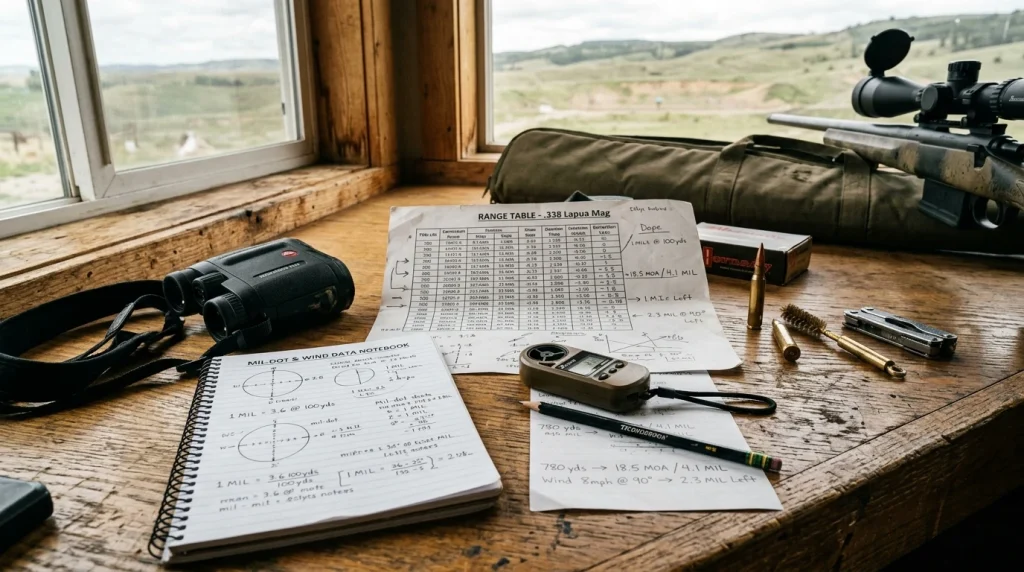
Modern precision shooters record their rifle DOPE (Data On Previous Engagements) indexed to Density Altitude increments (e.g., every 1,000 or 2,000 feet) rather than tracking raw elevation and temperature separately.
Advanced Ballistics: Rotational and Planetary Forces
At extreme ranges (beyond 800 meters), secondary aerodynamic and physical phenomena must be accounted for:
1. Gyroscopic Spin Drift
Because rifled barrels impart right-hand (clockwise) spin to stabilize the bullet, the projectile’s nose experiences a slight aerodynamic yaw into the trajectory curvature. This causes right-hand rifled bullets to drift laterally to the right, regardless of wind. For a typical 7.62 NATO round, spin drift accounts for approximately 6 to 10 inches of lateral displacement at 1,000 yards.
2. The Coriolis and Eötvös Effects
The Coriolis effect is caused by the Earth rotating beneath the bullet while it is in flight:
- Horizontal Coriolis: In the Northern Hemisphere, shots drift slightly to the right; in the Southern Hemisphere, they drift to the left.
- Vertical Coriolis (Eötvös Effect): When shooting east, the bullet travels in the direction of the Earth’s rotation, resulting in the target moving away and the bullet impacting high. When shooting west, the opposite occurs, causing the bullet to hit low.
Frequently Asked Questions
What is the difference between MOA and MRAD?
Minute of Angle (MOA) is based on dividing a degree into 60 minutes, where 1 MOA equals 1.047 inches at 100 yards. Milliradian (MRAD or Mil) is a metric-friendly angular measurement where 1 mil equals 10 centimeters at 100 meters, or 3.6 inches at 100 yards. Neither is inherently more accurate, but MRAD allows for faster decimal calculations in the field.
Why do bullets drop faster at longer distances?
Bullet drop increases quadratically over time ($D = 0.5gt²$). As the projectile travels downrange, air drag continuously reduces its forward velocity. Consequently, the bullet takes progressively longer to traverse each subsequent 100-yard interval, giving gravity more time to accelerate the bullet downward during the final portions of its flight.
How does temperature affect rifle muzzle velocity?
Most smokeless gunpowder formulations are temperature-sensitive. Higher ambient temperatures accelerate chemical burn rates within the cartridge chamber, generating higher peak chamber pressures and increasing muzzle velocity (often 1 to 2 fps per degree Fahrenheit). Lower temperatures cause reduced muzzle velocity, resulting in greater downrange trajectory drop.
What is a DOPE chart in marksmanship?
DOPE stands for “Data On Previous Engagements.” It is an empirical reference card detailing the exact elevation (drop) and windage corrections required for a specific rifle, scope, and ammunition combination at verified distances and environmental conditions.
Get our latest guides, news, and insights highlighted in your Google Search & AI Overviews.