✨ This article was AI edited. Editorial responsibility: SelfDefenseGuides.info.
Produced with AI. This article was artificially generated. Editorial responsibility: SelfDefenseGuides.info.
Choosing a firearm for personal protection is one of the most consequential safety decisions an individual can make. With hundreds of handgun models, operating mechanisms, and ammunition calibers available on the modern market, prospective defenders often find themselves overwhelmed by conflicting advice, marketing hype, and outdated ballistic myths.
Whether you are establishing a home defense perimeter, selecting an everyday concealed carry weapon (CCW), or evaluating defensive sidearms for vehicle security, understanding the critical engineering and physiological dynamics of guns for self defence is essential. In this detailed, data-backed guide, we analyze terminal ballistics, platform reliability standards, top-ranked defensive handguns, and legal criteria for responsible armed defense.
The Four Non-Negotiable Pillars of a Defensive Firearm
Unlike competition pistols or recreational plinking firearms, a dedicated self-defense gun must perform flawlessly under the worst physiological conditions imaginable: extreme stress, adrenaline dumps, compromised fine motor coordination, and low ambient light. Every defensive firearm must satisfy four foundational criteria:
- Uncompromising Mechanical Reliability: A defensive handgun must feed, fire, extract, and eject defensive hollow-point ammunition with a failure rate approaching zero (less than 1 failure per 1,000 rounds during rigorous function testing).
- Controllable Recoil & Split Times: Rapid, accurate follow-up shots are critical in defensive encounters. A caliber that produces excessive muzzle flip or wrist fatigue diminishes your practical hit probability.
- Ergonomics & Intuitive Grip Angle: Under acute danger, the firearm must naturally align with your eye-target line upon presentation from the holster without hunting for front sight alignment.
- Standardized Weapon-Mounted Light (WML) & Optic Compatibility: Over 70% of defensive shootings occur in diminished lighting conditions. Modern defensive pistols should feature an accessory rail for a positive identification light and an optic-ready slide cut for micro red dot sights.
Caliber Breakdown: 9mm Luger vs. .45 ACP vs. .380 ACP vs. 10mm
The caliber debate has raged in tactical circles for decades. However, modern forensic ballistic testing conducted by the Federal Bureau of Investigation (FBI) and independent ballistic laboratories has fundamentally changed the conversation.
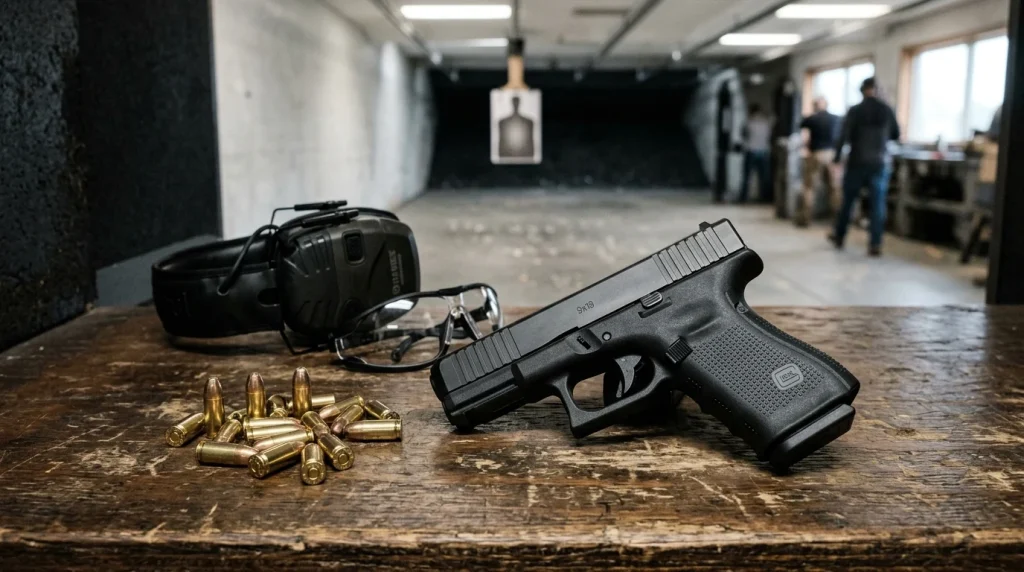
9mm Luger (9x19mm Parabellum) — The Industry Standard
Thanks to advancements in projectile metallurgy and skived jacketed hollow-point (JHP) engineering, premium 9mm loads (such as Federal HST 124gr or Speer Gold Dot 124gr +P) consistently achieve 14 to 18 inches of soft-tissue penetration in calibrated 10% ballistic gelatin with reliable expansion exceeding 0.60 inches. With lower recoil, higher magazine capacity (typically 12 to 17 rounds in compact frames), and significantly lower ammunition cost for continuous training, 9mm is universally recommended by law enforcement agencies and defensive instructors.
.45 ACP — The Traditional Heavyweight
While the .45 ACP delivers immense kinetic energy and a large initial bore diameter (.452 inches), it produces heavier recoil, slower split times between consecutive shots, and substantially reduces magazine capacity (typically 7 to 10 rounds in standard grips). Modern testing proves that premium expanding 9mm hollow points produce temporary and permanent wound cavities nearly indistinguishable from .45 ACP, making capacity and control the deciding factors.
.380 ACP (9mm Short) — Pocket Pistol Specialist
Operating at lower chamber pressures, .380 ACP enables ultra-compact micro pistols suitable for deep concealment. However, many .380 ACP JHP projectiles struggle to simultaneously achieve the FBI’s minimum 12-inch penetration requirement while fully expanding through heavy clothing barriers.
10mm Auto — Rural & Wilderness Defense
The 10mm Auto offers magnum-class velocities and deep penetration, making it the premier semi-automatic cartridge for defense against dangerous predatory wildlife (bears, mountain lions, wild boar). For human threats in urban settings, however, the excessive over-penetration risk and heavy recoil make it less optimal for everyday carry.
For in-depth ballistic comparisons, see our specialized breakdowns on 9mm self-defense ballistic performance and 10mm power vs. practicality.
Top-Ranked Guns for Self Defence: Platform Evaluation
The table below summarizes the top five battle-proven handguns currently dominating concealed carry and home defense, evaluated by operating mechanism, capacity, dimensions, and primary tactical application:
| Model | Caliber | Capacity | Action Type | Primary Role |
|---|---|---|---|---|
| Glock 19 Gen 5 | 9mm Luger | 15+1 | Striker-Fired | All-Round / Home & CCW |
| SIG Sauer P365X / XL | 9mm Luger | 12+1 / 17+1 | Striker-Fired | Concealed Carry (Micro-Compact) |
| Smith & Wesson M&P9 M2.0 Compact | 9mm Luger | 15+1 | Striker-Fired | Duty / Concealed Carry |
| CZ P-10 C | 9mm Luger | 15+1 | Striker-Fired | Value / Match-Grade Trigger |
| Ruger LCP Max | .380 ACP | 10+1 / 12+1 | Hammer-Fired (DAO) | Deep Pocket Concealment |
Handgun vs. Shotgun vs. Carbine for Home Defense
While handguns offer supreme portability, home defense introduces different tactical priorities where concealment is irrelevant and terminal lethality alongside collateral damage mitigation is paramount.
- 12-Gauge Defensive Shotgun: Loaded with quality 00 buckshot (9 pellets of lead shot moving at ~1,200 fps), a 12-gauge shotgun delivers unmatched immediate incapacitation at indoor room distances. However, heavy recoil, limited capacity (typically 5 to 7 shells), and the risk of short-stroking a pump action under stress require significant training.
- AR-15 Carbine (5.56x45mm NATO): Equipped with lightweight 55gr to 62gr fragmenting ballistic tip projectiles (such as Hornady V-Max or Speer Gold Dot), an AR-15 carbine exhibits surprising wall-penetration safety. Because high-velocity .223 projectiles fragment upon striking dry wall barriers, they often pose less ricochet and over-penetration hazard into adjacent rooms than solid pistol rounds. Coupled with 30-round standard capacity and negligible recoil, it represents an outstanding home defense platform.
- Defensive Handgun: Unbeatable for maneuverability, securing children with one free hand, and rapid deployment from quick-access biometric bedside safes.
For an exhaustive ranking of long guns versus handguns, read our companion guide on what gun is best for self defense across scenarios.
Essential Gear and Defensive Holster Selection
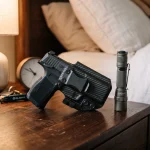
A defensive handgun is only as safe and effective as the holster carrying it. Never carry a defensive firearm loose in a pocket, purse, or unlined waistband. A proper holster must provide:
- Rigid Trigger Guard Coverage: Constructed from rigid molded Kydex, Boltaron, or thick reinforced steerhide that completely prevents foreign objects (clothing, keys, seatbelts) from depressing the trigger shoe.
- Positive Retention: The holster must securely retain the weapon during running, falling, or physical scuffling without unintentional dislodgement.
- Quality Belt Support: Pair your holster with a dedicated reinforced dual-layer nylon or steel-core EDC gun belt to prevent sagging and ensure a clean, snag-free draw stroke.
Legal Realities and the Justified Use of Deadly Force
Introducing a firearm into a self-defense confrontation instantly escalates the interaction to the level of deadly physical force under American jurisprudence. Regardless of whether a shot is fired or the weapon is merely drawn (brandished), the defender must be able to prove that five core legal elements were met:
- Innocence: You must not have been the initial aggressor or provoked the conflict.
- Imminence: The threat of death or serious bodily injury must be happening right now—not minutes ago or threats of future retaliation.
- Proportionality: Deadly force can only be met with deadly force or to prevent designated violent felonies (rape, armed robbery, home invasion).
- Avoidance / Retreat: In duty-to-retreat states, you must make a safe retreat if available; in Stand Your Ground states, retreat is not legally mandated if you are in a place where you have a lawful right to be.
- Reasonableness: A reasonable person in identical circumstances, with identical knowledge, would have believed that deadly force was necessary to survive.
To understand the specific statutory definitions in your jurisdiction, consult our state-by-state self-defense legal overview and our analysis on foundational self-defense weapons.
Frequently Asked Questions: Defensive Guns
What is the single best gun for self defence for beginners?
The Glock 19 (9mm) or Smith & Wesson M&P9 M2.0 Compact are widely regarded as the best first defensive guns. Their compact dimensions allow both home defense and concealed carry, while their proven striker-fired reliability and manageable recoil simplify weapon handling.
Is 9mm powerful enough for home defense?
Yes. Loaded with quality defensive hollow-point ammunition (such as Federal HST or Speer Gold Dot), modern 9mm ammunition delivers penetration and expansion exceeding FBI ballistic protocols with minimal recoil and high magazine capacity.
Are revolvers better than semi-automatics for self defense?
Revolvers offer extreme mechanical simplicity and are immune to limp-wristing malfunctions, making them appealing to some novices. However, their limited capacity (5 to 6 rounds), heavy double-action trigger pulls, and slow reloads give modern semi-automatics a major tactical advantage.
What ammunition should I load in my self-defense firearm?
Always use factory-loaded Jacketed Hollow Point (JHP) ammunition from reputable manufacturers. Never use Full Metal Jacket (FMJ) target rounds for personal defense, as FMJ rounds over-penetrate human targets without expanding, risking bystanders behind the threat.
Get our latest guides, news, and insights highlighted in your Google Search & AI Overviews.