✨ This article was AI edited. Editorial responsibility: SelfDefenseGuides.info.
Produced with AI. This article was artificially generated. Editorial responsibility: SelfDefenseGuides.info.
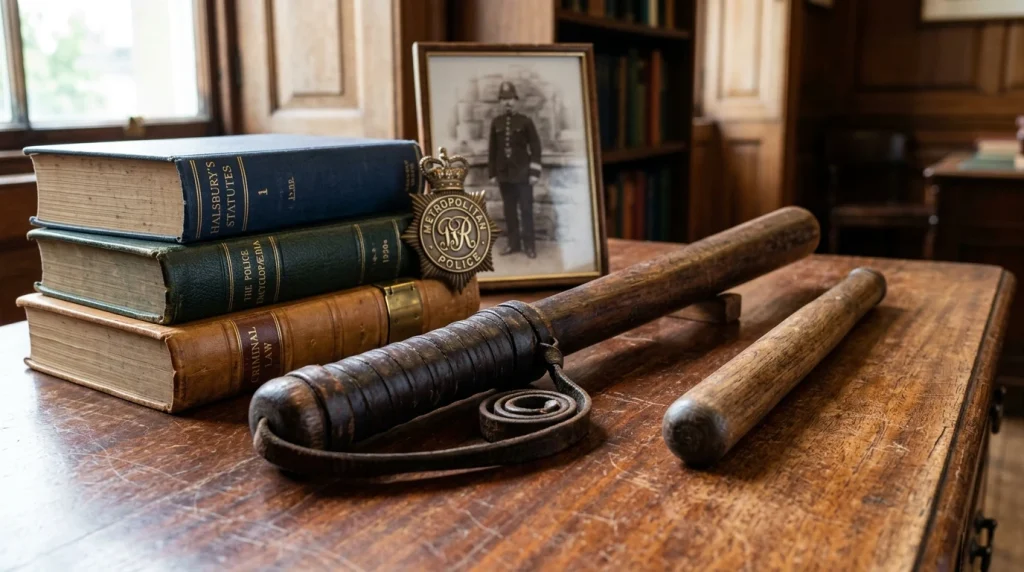
The iconic silhouette of the British police constable patrolling fog-draped Victorian streets with a turned wooden truncheon is etched into historical memory. Over decades of specialized tactical evolution, British and Commonwealth law enforcement agencies experimented with various impact implements, including spring-loaded coshes, heavy leather-wrapped billies, and leather-sleeved nightsticks designed to subdue violent suspects with blunt kinetic force.
Today, antique collectors, martial artists, and personal safety enthusiasts frequently query the legal boundaries surrounding the leather nightstick in the UK. Whether you have inherited a vintage leather-bound police truncheon, encountered a leather sap online, or are researching the parameters of self-defense equipment under British jurisprudence, navigating the United Kingdom’s rigid offensive weapons statutory framework is mandatory. In this exhaustive legal guide, we analyze the governing legislation, Crown Prosecution Service (CPS) charging standards, historical origins, and private possession rules.
Historical Origins of the Leather Nightstick in British Policing
Prior to the adoption of modern expandable friction-lock batons (such as Monadnock and ASP batons) and PAVA incapacitant spray in the late 1990s, British constabularies relied exclusively on wooden truncheons and leather-covered impact implements:
- Victorian Wooden Truncheons: Hand-turned from dense hardwoods such as lignum vitae, cocuswood, or English oak, often decorated with royal ciphers and municipal constabulary crests.
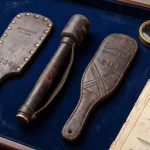
- Leather-Covered Billies & Saps: Used extensively by plainclothes detectives, railway police, and dockyard constables. Encasing a lead or steel core in sewn saddle leather prevented splintering, absorbed shock to the officer’s wrist, and reduced external lacerations compared to sharp wooden edges.
- Mounted Police Long Batons: Lengthy wooden and leather-sheathed nightsticks deployed by cavalry and mounted divisions for crowd containment.
Primary UK Legislation Governing Batons & Impact Weapons
Unlike the United States, where the Second Amendment protects individual weapon carriage and states vary widely on impact weapon rules, the United Kingdom maintains one of the most restrictive legal frameworks in the democratic world regarding offensive weapons.
1. Prevention of Crime Act 1953 (Section 1)
Section 1(1) of the Prevention of Crime Act 1953 establishes that any person who, without lawful authority or reasonable excuse (the proof whereof lies upon him), has with him in any public place any offensive weapon shall be guilty of an offence.
Under UK case law, offensive weapons fall into three distinct judicial categories:
- Weapons Made for Causing Injury: Items manufactured specifically to cause injury to the person (e.g., truncheons, nightsticks, batons, daggers, bayonets). These are offensive weapons per se; the prosecution does not need to prove intent.
- Weapons Adapted for Causing Injury: Everyday items modified to cause harm (e.g., a broken bottle, a heavy walking cane weighted with lead).
- Weapons Intended for Causing Injury: Innocent items carried with the specific subjective intention of using them to injure someone (e.g., carrying a baseball bat in a nightclub).
Because a leather nightstick or police truncheon is manufactured specifically as an impact weapon designed to inflict bodily trauma, it is categorized as an offensive weapon per se. Carrying one in any public place without statutory authority (such as being a serving police officer on duty) is an immediate criminal offence.
2. Criminal Justice Act 1988 (Section 141 & Offensive Weapons Orders)
Section 141 of the Criminal Justice Act 1988 prohibits the manufacture, sale, importation, loan, or gifting of specified weapons listed in the Criminal Justice Act 1988 (Offensive Weapons) Order. Over successive statutory updates, the schedule of prohibited weapons has expanded to explicitly include:
- Straight, side-handled, or friction-lock batons (telescopic truncheons).
- Knuckledusters and weighted gloves.
- Blowpipes, swordsticks, and disguised blades.
- Kusari-gama and kyoketsu-shoge.
3. The Offensive Weapons Act 2019: The Private Possession Prohibition
For decades, British citizens were legally permitted to possess prohibited offensive weapons (such as antique truncheons, swords, and martial arts weapons) inside their own private homes, provided they never brought them into public spaces. However, the Offensive Weapons Act 2019 dramatically altered this boundary.
Under Section 46 of the 2019 Act, it is now an offence to possess certain specified offensive weapons even in private (including inside your private dwelling, attic, or secure display cabinet). While straight traditional wooden truncheons retained certain antique exemptions (specifically if manufactured before 1954 or over 100 years old), expandable batons, telescopic truncheons, and modern tactical nightsticks became illegal to possess anywhere in England, Wales, and Scotland.
Can You Carry Any Weapon for Self-Defense in the UK?
A widespread misconception among overseas observers is that UK citizens can carry non-lethal defensive tools (such as pepper spray, stun guns, or pocket saps) for personal safety. Under UK law:
- Self-Defense Is Not a \”Reasonable Excuse\”: Carrying any object in anticipation of a potential physical confrontation is legally considered arming oneself with an offensive weapon. The courts have repeatedly ruled that general fear of crime or walking through high-crime neighborhoods does not constitute a valid \”reasonable excuse\” under Section 1 of the 1953 Act.
- Pepper Spray & Stun Guns Are Section 5 Firearms: Under Section 5(1)(b) of the Firearms Act 1968, noxious liquid sprays (including CS gas, OC pepper spray, and PAVA) are classified as prohibited firearms, carrying mandatory minimum prison sentences for possession.
To contrast UK defensive limitations with American state-level statutes, review our analysis on state-by-state self-defense legal codes and our breakdown of legal self-defense weapons around the world.
Legal Comparison: Impact Tools & Weapons Under UK Law
| Item Description | Public Carriage Status | Private Home Possession | Statutory Basis |
|---|---|---|---|
| Leather Nightstick / Sap | Strictly Illegal (Offensive Weapon) | Restricted / Antique Exempt Only | PCA 1953 / CJA 1988 |
| Expandable Steel Baton | Strictly Illegal | Strictly Illegal (Banned in Private) | Offensive Weapons Act 2019 |
| Antique Victorian Truncheon (>100 yrs) | Illegal (Unless in transit to museum/fair) | Lawful (Curio / Collector Exemption) | OWA 2019 Antique Defences |
| Heavy Flashlight (Maglite) | Lawful (Subject to context/intent) | Fully Lawful | Everyday Utilitarian Tool |
| Criminal Deterrent Marker Dye | Lawful (Non-toxic stain spray) | Fully Lawful | Unregulated Dye Marker |
Penalties for Possessing an Offensive Weapon in the UK
The Crown Prosecution Service prosecutes weapons offences vigorously under the Sentencing Council guidelines. An individual convicted of carrying an offensive weapon under Section 1 of the Prevention of Crime Act 1953 faces severe penalties:
- Summary Conviction (Magistrates’ Court): Up to 6 months’ custody (or 12 months for offences committed after May 2022) and/or an unlimited fine.
- Indictment Conviction (Crown Court): Up to 4 years’ immediate imprisonment and an unlimited fine.
- Second-Strike Mandatory Minimums: Under Section 28 of the Criminal Justice and Courts Act 2015, any adult convicted of a second offensive weapon offence faces a mandatory minimum custodial sentence of 6 months, unless exceptional circumstances apply.
Lawful Personal Safety Strategies in the United Kingdom
Given the categorical prohibition against carrying weapons in public, personal safety in the UK relies on non-weapon methods:
- High-Decibel Personal Alarms: Handheld panic alarms that emit a 130dB to 140dB piercing siren are completely lawful, draw immediate public attention, and disrupt predatory ambushes.
- UK-Legal Criminal Identification Dye: Sprays such as Farbgel contain non-toxic purple or UV marking dye that coats an attacker’s skin and clothing without noxious chemicals, assisting police forensic identification without violating the Firearms Act.
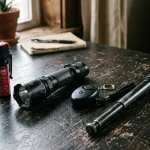
- Tactical Illumination Flashlights: Compact high-candela LED torches carried for illumination provide temporary night-vision disruption without being manufactured as offensive weapons.
- Situational Awareness Training: Avoiding transitional hazards, tracking environmental exits, and verbal de-escalation remain the premier defensive protocol.
For more insights on unarmed self-defense systems, consult our guide to martial arts combat effectiveness and our primer on foundational self-defense equipment.
Frequently Asked Questions: UK Nightstick & Baton Laws
Can I legally own a leather nightstick in my home in the UK?
Possession in private depends on age and construction. Traditional antique wooden/leather truncheons over 100 years old retain collector exemptions under the Offensive Weapons Act 2019. Modern tactical telescopic batons and saps are illegal even in private dwellings.
Can I carry a nightstick or truncheon in my car in the UK?
No. A motor vehicle parked on or driving along a public highway is legally defined as a public place under Section 1 of the Prevention of Crime Act 1953. Carrying a nightstick in your car is an offensive weapon offence punishable by up to 4 years in prison.
Is self-defense a valid legal excuse for carrying an impact tool in the UK?
No. Under UK judicial precedent, carrying an item in anticipation of self-defense does not constitute a ‘reasonable excuse’. Arming yourself preemptively converts the object into an offensive weapon.
What defensive tools are legal to carry in public in the UK?
High-decibel personal panic alarms (130dB+), criminal identification marking dye sprays (such as Farbgel), and standard high-lumen pocket flashlights carried for illumination are lawful in the UK.
Get our latest guides, news, and insights highlighted in your Google Search & AI Overviews.