✨ This article was AI edited. Editorial responsibility: SelfDefenseGuides.info.
Produced with AI. This article was artificially generated. Editorial responsibility: SelfDefenseGuides.info.
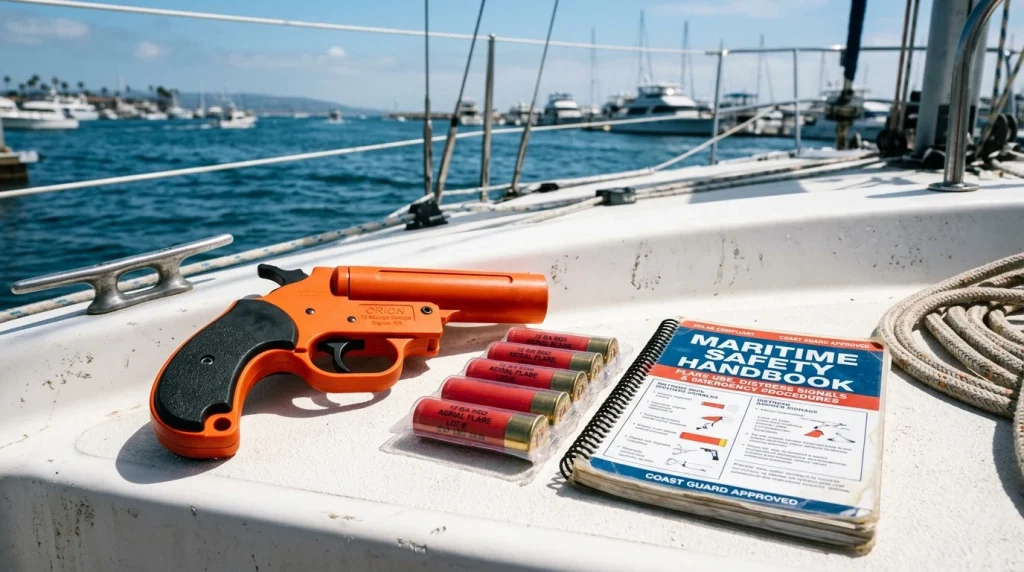
Every year, recreational boaters, coastal outdoor enthusiasts, and survivalists equip themselves with visual distress signaling devices (VDSDs). Among the most recognizable emergency tools is the bright orange polymer flare launcher—frequently manufactured by safety brands such as Orion in 12-gauge or 25mm calibers. While these devices are mandated safety equipment aboard federally regulated vessels, confusion abounds regarding their legal status ashore.
Specifically, many people ask: is shooting a flare gun illegal? Can you discharge a flare gun to test expired cartridges? Can you shoot a flare gun during a neighborhood fireworks display? And what happens if someone discharges a flare gun in self-defense against a violent home intruder or carjacker? In this comprehensive legal analysis, we examine United States Coast Guard (USCG) regulations, federal criminal statutes, Bureau of Alcohol, Tobacco, Firearms and Explosives (ATF) classifications, and state-level penal codes governing visual distress devices.
Federal Maritime Law: Authorized Distress Signaling
Under United States Coast Guard regulations codified in Title 33 of the Code of Federal Regulations (33 CFR § 175.140), recreational vessels operating on coastal waters, the Great Lakes, territorial seas, and connecting waters are legally required to carry approved visual distress signals. Approved equipment includes aerial pyrotechnic flare guns, handheld flares, and orange smoke signals.
However, federal maritime law restricts the discharge of pyrotechnic signaling devices strictly to genuine emergency distress conditions. When a visual distress flare is fired over open waters, it triggers an immediate, multi-agency emergency search and rescue (SAR) operation involving Coast Guard cutters, response boats, and MH-60 Jayhawk helicopters.
Penalties for False Distress Signals: 14 U.S.C. § 521
Under 14 U.S. Code § 521, knowingly transmitting or causing to be transmitted a false distress signal to the Coast Guard—or creating the appearance of a maritime emergency by firing an aerial flare into coastal skies—is a severe federal offense:
- Federal Felony: Classified as a Class D felony punishable by up to 5 to 10 years of federal imprisonment.
- Criminal Penalties: Criminal fines of up to $250,000 for individuals.
- Mandatory Civil Liability: The offender is held personally liable for all costs incurred by the United States Coast Guard and local first responders during the resulting search and rescue operation. These SAR operational expenses routinely exceed $50,000 to $100,000 per incident.
ATF Classification: Is a Flare Gun a Firearm?
One of the most complex legal inquiries involves whether a flare gun is classified as a firearm under federal law. The Gun Control Act of 1968 (GCA), codified at 18 U.S.C. § 921(a)(3), defines a firearm as any weapon which will, is designed to, or may readily be converted to expel a projectile by the action of an explosive.
However, the Bureau of Alcohol, Tobacco, Firearms and Explosives (ATF) explicitly exempts visual distress signaling devices from standard firearm regulation under 27 CFR § 478.11, provided they meet specific criteria:
- Manufactured Exclusively for Signaling: The device must be designed and intended solely for emergency signaling, such as standard plastic 12-gauge or 25mm marine flare launchers.
- No Ready Conversion: The launcher’s polymer frame must not be readily convertible to discharge conventional centerfire or rimfire shotgun shells.
- Sub-Caliber Adapter Prohibitions: A dangerous legal trap exists when individuals purchase metal sub-caliber chamber inserts (e.g., adapters that allow a 12-gauge flare gun to chamber .22 LR, 9mm, or .410 bore shotgun shells). The ATF has repeatedly ruled that inserting a metal sleeve into a flare gun immediately transforms the plastic launcher into a firearm under the GCA—and potentially an unregistered Any Other Weapon (AOW) under the National Firearms Act (NFA), exposing the owner to 10 years in federal prison. Furthermore, firing high-pressure commercial ammunition through a polymer flare gun usually results in catastrophic chamber rupture, causing severe hand and facial amputations.
Discharging a Flare Gun on Land: State Criminal Codes
Outside the maritime context, firing a flare gun on municipal streets, suburban neighborhoods, national forests, or public parks is almost universally illegal under state and municipal penal codes. Charges routinely filed by local prosecutors include:
1. Reckless Endangerment
Aerial flares burn magnesium and strontium nitrate at temperatures exceeding 2,000°F (1,093°C) to 3,000°F. When fired into the air over populated areas, the heavy, burning projectile will inevitably descend. Discharging a burning chemical projectile into public airspace creates a substantial, unjustifiable risk of physical injury or death to bystanders, fulfilling the statutory definition of Reckless Endangerment (often charged as a Class A misdemeanor or low-level felony).
2. Unlawful Discharge of a Weapon / Fireworks Violations
Most municipalities enforce strict ordinances prohibiting the discharge of projectile devices or unauthorized pyrotechnics within city limits. Firing a flare gun on the Fourth of July or New Year’s Eve violates municipal noise, projectile, and fireworks safety ordinances.
3. Arson and Wildfire Liability
If an aerial flare lands on a residential roof, dry woodland, or grassland and sparks a fire, the shooter faces immediate felony arson or reckless burning charges. In Western states (California, Arizona, Colorado), causing a wildfire through reckless flare discharge incurs catastrophic civil restitution debts for firefighting response costs alongside multi-year prison sentences.
Using a Flare Gun in Self-Defense: Lethal Force Realities
Occasionally, internet forums debate using a marine flare gun as an improvised home defense or vehicle protection weapon. While a flare gun may visually resemble a large-caliber handgun, employing one defensively involves severe tactical and legal hazards.
| Factor | Defensive Handgun (9mm) | Marine Flare Gun (12-Ga) |
|---|---|---|
| Terminal Ballistics | Predictable 14–18\” penetration & expansion | Poor ballistic penetration; severe thermal burn |
| Capacity & Reload Time | 10–17 rounds; 2-second reload | Single shot; slow break-action reload |
| Collateral Fire Hazard | Extremely low (non-incendiary) | Extreme (Ignites dry wall, carpets, curtains) |
| Legal Classification of Force | Deadly Physical Force | Deadly Physical Force (Incendiary Weapon) |
| Criminal Liability Risk | Protected under Castle Doctrine / Self-Defense | Severe risk of Aggravated Assault / Arson claims |
The Legal Standard of Force
Firing a 2,000°F burning chemical projectile at a human being is legally classified as deadly physical force. If you are justified in using deadly force (e.g., facing imminent death, forcible rape, or violent armed burglary), you are legally permitted to use whatever tool is necessary to preserve life. However, if the legal threshold for deadly force is not met, shooting someone with a flare gun constitutes Assault with a Deadly Weapon or Attempted Murder. Furthermore, missing the target inside your own home will immediately set your residence on fire, trapping you and your family.
For detailed legal frameworks on lethal vs. non-lethal defense, see our guide on state self-defense statutory protections and our analysis of proven self-defense weapons.
Proper Disposal of Expired Flare Gun Cartridges
Marine pyrotechnic flares typically carry a manufacturer expiration date of 42 months (3.5 years) from the date of manufacture. Once expired, boaters often wonder how to legally dispose of old rounds. Never shoot expired flares into the sky to test them. Recommended legal disposal methods include:
- Household Hazardous Waste (HHW) Collection: Most municipal and county waste management departments host designated hazardous waste drop-off days for flares.
- Local Fire Departments: Many municipal fire stations accept expired flares for safe controlled disposal or training exercises.
- Coast Guard Auxiliary / Power Squadron Units: Volunteer auxiliary units frequently coordinate flare disposal and demonstration seminars for boaters.
Frequently Asked Questions: Flare Gun Laws
Can I legally shoot a flare gun on my own private land?
Generally no. Unless you reside on isolated rural acreage with zero fire danger and local permits, discharging an aerial flare violates municipal noise, open burning, and projectile ordinances, and risks triggering false emergency responses if visible from highways or waterways.
Is it a felony to shoot a flare gun into the sky without an emergency?
Yes. Under 14 U.S.C. § 521, knowingly transmitting a false distress signal that prompts a Coast Guard search and rescue operation is a federal Class D felony punishable by up to 10 years in prison and full financial restitution for search costs.
Can a felon legally own a flare gun in the United States?
Under federal ATF regulations, unmodified marine safety flare launchers are classified as signaling devices rather than firearms under the Gun Control Act. However, some individual state statutes (such as California or New York) define any explosive projectile launcher as a firearm, potentially restricting prohibited persons under state penal codes.
Is a flare gun effective for home defense?
No. Flare guns make terrible defensive weapons: they are single-shot, slow to reload, lack stopping power, and create an uncontrollable indoor fire hazard that endangers the homeowner and family.
Get our latest guides, news, and insights highlighted in your Google Search & AI Overviews.