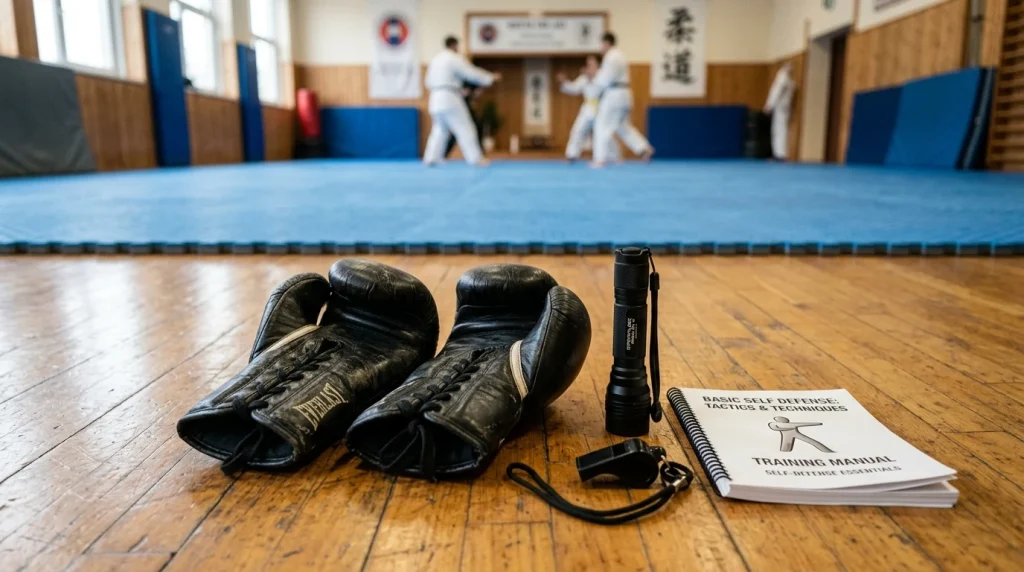
When embarking on a journey to protect yourself and your family, the most fundamental dilemma almost everyone faces is: which is better for self defense? Should you spend years mastering a traditional martial art like Brazilian Jiu-Jitsu or Krav Maga? Should you invest in specialized everyday carry (EDC) tools like pepper spray, tactical flashlights, or concealed handguns? Or should you prioritize mental conditioning and environmental awareness?
Far too many personal defense instructors advocate strictly for their own commercial specialty. Martial artists claim physical technique is everything; firearms instructors argue that distance and ballistics render unarmed combat obsolete; and self-defense theorists claim avoidance solves all problems. In reality, violent street encounters are dynamic, asymmetric, and unforgiving. Relying on a single defensive pillar creates catastrophic security vulnerabilities. In this guide, we evaluate the scientific, tactical, and legal realities across all three disciplines to help you construct an unshakeable, layered survival protocol.
The Self-Defense Triad: Mindset, Tools, and Physical Capability
Effective personal protection operates on a tiered hierarchy often referred to by tactical analysts as the Survival Triad:
- Tier 1: Environmental Awareness & De-Escalation (Pre-Conflict): Identifying behavioral anomalies, maintaining distance, and defusing hostility before physical violence occurs.
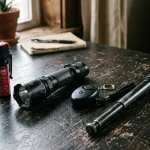
- Tier 2: Distance Tools & Force Multipliers (Mid-Conflict): Utilizing non-lethal deterrents (stream pepper spray, high-candela strobe flashlights) to halt an advance at 10 to 20 feet without entering grappling range.
- Tier 3: Empty-Hand Combat & Close-Quarters Retention (Post-Ambush): Executing explosive gross-motor strikes, joint defense, and weapon retention when surprised or physically pinned.
Situational Awareness: The Undisputed Foundation
Without situational awareness, martial arts black belts and armed citizens alike are frequently incapacitated before they even realize a threat exists. Violent predators rely on surprise, ambush angles, and transitional spaces (parking lots, stairwells, gas stations, ATMs) to eliminate their victim’s reaction time.
The OODA Loop Advantage
Developed by military aviation strategist Col. John Boyd, the OODA Loop—Observe, Orient, Decide, Act—dictates who wins a confrontation. In an ambush, the attacker has already completed their Observe, Orient, and Decide phases; they are actively executing their Action. If you are distracted by your smartphone, wearing noise-canceling headphones, or unaware of your surroundings, your reaction will lag behind their action by 1.5 to 3.0 seconds—an eternity in a close-quarters assault.
Cooper’s Color Code of Mental Awareness
- Condition White (Unaware / Oblivious): Completely tuned out. If attacked here, your only defense is blind luck.
- Condition Yellow (Relaxed Alertness): The baseline state for everyday carry. You observe people’s hands, track entry and exit points, and scan 360 degrees without paranoia.
- Condition Orange (Specific Threat Assessment): You identify a potential anomaly—such as an individual matching your pace, concealing hands, or target-glancing. You actively create physical distance or position obstacles between you and the threat.
- Condition Red (Active Fight / Tactical Response): The threat commits to an attack; your response protocol triggers instantly.
Martial Arts for Self-Defense: Reality vs. Gym Sport
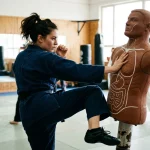
Physical training is essential for inoculating your central nervous system against the fight-or-flight adrenaline surge. However, not all combat sports translate effectively to concrete sidewalks and multiple assailants.
Striking Disciplines: Boxing & Muay Thai
Striking disciplines provide the single most important physical skill: standing on your feet, maintaining balance, and delivering concussive damage while escaping. Boxing instills head movement, distance management, and powerful hand strikes. Muay Thai adds devastating low kicks, elbows, and knees from the clinch. For street survival, upright striking allows you to scan for secondary attackers and sprint to safety.
Grappling Disciplines: Brazilian Jiu-Jitsu (BJJ) & Judo
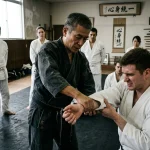
BJJ is unmatched for dominant control in a one-on-one scenario, particularly against an untrained opponent on the ground. However, sport BJJ encourages pulling guard and staying on the ground. In real-world violence, taking an altercation to the pavement exposes you to curb impacts, broken glass, hidden blades, and soccer kicks from the attacker’s associates. Use grappling defensively to break grips, stand up, and disengage—not to hunt for sport submissions.
Reality-Based Systems: Krav Maga
Originating in military close-quarters combat, Krav Maga emphasizes aggressive counter-attacks targeting vulnerable anatomical structures (eyes, throat, groin), simultaneous defense and attack, and active defense against edged weapons. While valuable for mindset, quality control across commercial civilian academies varies widely.
For detailed comparisons, read our combat analysis on which martial arts is best for self defense and our review of boxing effectiveness in real street encounters.
Defensive Tools: Force Multipliers and Distance Management
When physical disparity (such as being attacked by a perpetrator 80 pounds heavier) makes hand-to-hand combat a losing proposition, defensive tools equalize the encounter.
Non-Lethal Everyday Carry: Pepper Spray & High-Lumen Strobes
High-concentration Oleoresin Capsicum (OC) pepper spray (stream or gel formulations) is arguably the most practical EDC defense tool for modern civilians. It provides:
- Engagement at 10 to 15 Feet: Eliminates the need to engage in dangerous hand-to-hand combat.
- Involuntary Physiological Disruption: Forces immediate closure of the eyelids, intense burning sensation, and involuntary coughing, regardless of the attacker’s physical pain tolerance or intoxication.
- Broad Legal Acceptance: Lawful in all 50 states with minimal liability risks compared to impact tools or edged weapons.
Firearms: The Pinnacle of Lethal Defense
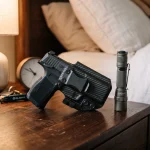
A concealed handgun provides absolute stopping power against imminent deadly threats. However, carrying a firearm demands rigorous legal education, continuous marksmanship training, safe storage, and complete mastery of holster draw mechanics under stress. For complete firearm evaluations, see our guide to top firearm picks ranked for defense.
Comparison Matrix: Evaluating the Three Defensive Approaches
| Defensive Discipline | Learning Curve | Engagement Range | Multiple Attackers | Legal Liability Risk |
|---|---|---|---|---|
| Situational Awareness | Immediate (Days) | Pre-contact (30+ feet) | Excellent (Avoids group ambushes) | Zero Legal Risk |
| Non-Lethal Tools (OC Spray) | Low (Hours of practice) | Intermediate (10–15 feet) | Moderate (Stream coverage) | Very Low Risk |
| Empty-Hand Martial Arts | High (1–3 years) | Contact / Clinch (0–3 feet) | Poor (Extreme physical risk) | Moderate (Assault claims) |
| Concealed Firearm | High (Continuous training) | Contact to Extended Range | High (Magazine capacity dependent) | Extreme (Deadly force criteria) |
The Ultimate Verdict: Building Your Layered Defense Strategy
So, which is truly better for self defense? The definitive answer is that no single discipline is superior on its own. True personal safety is achieved when all three disciplines function synergistically:
- First Priority: Cultivate Condition Yellow situational awareness. Never walk with your eyes glued to a phone screen in public spaces.
- Second Priority: Carry reliable non-lethal defense tools (a quality OC stream pepper spray and a compact high-candela flashlight) everywhere you go.
- Third Priority: Train in an upright striking and grappling defense martial art (such as Boxing, Muay Thai, or fundamental BJJ) 2–3 days per week to build stress tolerance, physical conditioning, and muscle memory.
- Fourth Priority (Optional/Advanced): If legally permissible and personal circumstances warrant, obtain professional concealed firearm instruction to prepare for life-threatening lethal violence.
For more foundational legal analysis on state-level defensive regulations, explore our comprehensive state-by-state self-defense laws guide and our breakdown of legal weapons used in modern self-defense.
Frequently Asked Questions About Choosing Self-Defense Methods
Is running away considered effective self defense?
Yes. Tactical disengagement and running to safety is the single highest-percentage self-defense technique. Escaping guarantees your physical survival and eliminates all potential criminal and civil legal liabilities.
Can a beginner rely on martial arts alone for self defense?
No. It typically takes 6 to 18 months of consistent live sparring and pressure testing before an individual can reliably execute empty-hand techniques against a larger, resisting adversary under real-world adrenaline conditions.
What is the easiest defensive tool to carry every day?
Stream or gel-based pepper spray is the most practical everyday carry item. It is legal across all 50 states, requires minimal motor skill to deploy, and halts aggressors from 10 to 12 feet away without permanent injury.
How does situational awareness prevent physical fights?
By operating in Cooper’s Condition Yellow, you recognize pre-attack indicators (pacing, target glancing, concealed hands, unnatural proximity) early enough to change routes, cross the street, or enter a safe public establishment before an ambush occurs.
Get our latest guides, news, and insights highlighted in your Google Search & AI Overviews.