✨ This article was AI edited. Editorial responsibility: SelfDefenseGuides.info.
Produced with AI. This article was artificially generated. Editorial responsibility: SelfDefenseGuides.info.
In the annals of personal defense, law enforcement gear, and mid-century criminal lore, few weapons command as much grim respect as the blackjack weapon (often referred to simply as a jack). Compact enough to conceal in an overcoat pocket or slide into a specialized trouser seam, the blackjack was engineered for one singular purpose: to deliver decisive, incapacitating blunt-force kinetic energy at arm’s reach.
Whether you are a collector of antique tactical equipment, a martial artist studying impact biomechanics, or a defensive practitioner examining historical force options, understanding the true mechanics of jack weapons is essential. In this comprehensive technical analysis, we dissect the internal construction, spring physics, medical injury profiles, policing history, and contemporary legal status of blackjacks under modern statutory codes.
Anatomy of a Classic Blackjack: What Makes It Work?
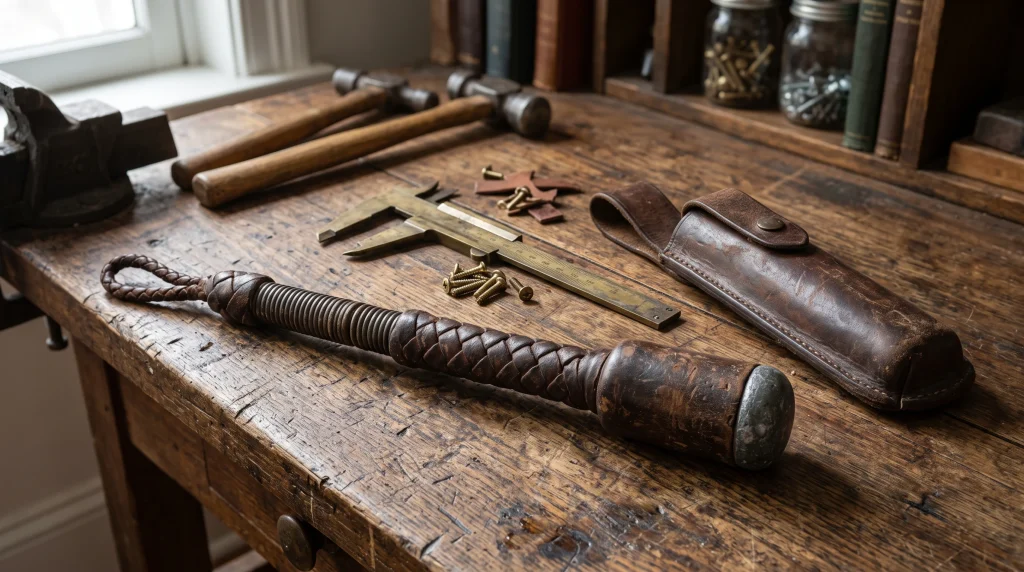
At first glance, a blackjack may appear to be nothing more than a leather club. In reality, authentic vintage blackjacks—such as those manufactured by classic American makers like Bucheimer, Tex Shoemaker, Jay-Pee, and Brauer Bros—are sophisticated mechanical impact devices built with tight engineering tolerances:
- The Lead Core (Head): Positioned at the distal end of the weapon, the striking head consists of a solid cast lead slug or tightly packed lead birdshot weighing between 6 and 14 ounces. Lead’s remarkable density (~11.34 g/cm³) allows extreme kinetic mass to be concentrated into a compact 1-inch to 1.5-inch diameter cylinder.
- The Coiled Steel Spring: The structural backbone connecting the handle to the lead head is a heavy-gauge helical steel spring. Unlike a rigid wooden billy club, this spring bends during the backswing and snaps forward with explosive acceleration upon forward release, creating a mechanical whip effect.
- The Outer Leather Casing: Tightly stretched vegetable-tanned cowhide or hand-braided rawhide envelopes the spring and lead core. The leather protects the spring from moisture and corrosion, prevents the coils from pinching the user’s hand during hard impacts, and cushions the blow just enough to distribute kinetic shock through underlying tissue.
- The Pommel & Wrist Loop: A flared leather pommel integrated with a sturdy leather lanyard prevents the weapon from slipping out of the user’s grasp when hands are slick with sweat or rain.
Kinetic Physics: The Spring-Leverage Advantage
The destructive power of a blackjack stems from the physics of dynamic momentum transfer. When an individual swings a rigid stick or baton, the velocity of the impact point is governed strictly by the angular velocity of the shoulder, elbow, and wrist joints. However, a spring-loaded blackjack functions as a two-stage compound pendulum:
- Energy Storage Phase: During the initial swing, the inertia of the heavy lead head causes the spring to flex backward, storing elastic potential energy within the coiled steel.
- Release & Amplification: As the officer’s arm reaches full extension and begins to decelerate, the stored elastic energy in the spring snaps forward. This slingshots the lead head into the target at nearly double the velocity of a rigid club of identical length.
- Complete Energy Dissipation: Because lead is a relatively malleable metal, the striking head does not bounce off the target. Upon contact, the lead payload deforms microscopically, transferring virtually 100% of its kinetic energy into the underlying bone and muscle tissue without transferring recoil shock back into the user’s wrist.
Medical Trauma Profile: Why Blackjacks Are Classified as Deadly Force
During the early and mid-20th century, blackjacks were frequently marketed to night watchmen and police officers as \”non-lethal\” subdual tools. However, medical trauma data collected over decades paints a drastically different picture.
When directed at the human cranium or upper cervical spine, a strike from an 8-to-12-ounce lead blackjack produces catastrophic biological trauma:
- Depressed Cranial Fractures: The concentrated focal point of the cylindrical head crushes outer and inner tables of the skull with minimal striking effort.
- Epidural & Subdural Hematomas: The violent kinetic shock wave shears delicate meningeal blood vessels between the skull and the brain dura, resulting in rapid intracranial bleeding that can cause brain herniation and death within hours.
- Cerebral Contusions & Diffuse Axonal Injury: The rapid acceleration-deceleration of the head causes the brain to rebound violently against the interior of the skull (coup-contrecoup injury), causing irreversible neurological deficit.
Because of this high lethality index, modern American courts and police force matrices uniformly classify any deliberate strike to the head or neck with an impact weapon as deadly physical force—legally equivalent to discharging a firearm.
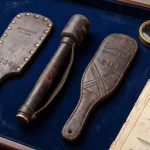
Slap Jack vs. Round Blackjack: Key Differences
While often grouped together under generic legal definitions of \”saps,\” flat slap jacks and round blackjacks possess distinct tactical properties:
| Design Feature | Cylindrical Blackjack | Flat Slap Jack (Beaver Tail) |
|---|---|---|
| Striking Surface | Narrow, cylindrical focal point | Wide, flat paddle face |
| Internal Core | Coiled helical steel spring | Flat tempered spring steel shank |
| Impact Effect | Penetrating concussive shock; high fracture risk | Dispersed nerve disruption; lower fracture risk |
| Pocket Profile | Bulky cylinder (~1.25\” thick) | Ultra-flat (~0.5\” thick); easy pocket carry |
Legal Status of Blackjacks in Modern Jurisdictions
Due to their association with 19th-century street footpads, prohibition-era gangsters, and unregulated police brutality, blackjacks are among the most broadly banned impact weapons in statutory penal codes:
Prohibitions in Major US States
- California: Under California Penal Code § 22210, possessing, manufacturing, or carrying any blackjack or sap is a wobbler offense punishable by up to 3 years in state prison.
- New York: Under NY Penal Law § 265.01, mere possession of a blackjack is a Class A misdemeanor, regardless of whether it is carried concealed or kept in a home collection.
- Illinois: Under 720 ILCS 5/24-1, possessing a blackjack with intent to use it unlawfully is a misdemeanor, and carrying one concealed is heavily restricted.
- Texas Exception: In 2019, Texas HB 446 removed blackjacks, saps, and clubs from the list of prohibited weapons under Texas Penal Code § 46.05, allowing adults to carry them without permits.
For more foundational legal analysis on state-level defensive regulations, explore our comprehensive state-by-state self-defense laws guide and our breakdown of legal weapons used in modern self-defense.
Frequently Asked Questions: Blackjack Weapons
Why is it called a blackjack?
The exact historical origin is debated, but 19th-century accounts suggest the name derived from ‘jack’ (a small leather drinking vessel or club) coated in black leather or pitch.
Is a blackjack considered a firearm?
No. Under federal and state laws, a blackjack is classified as an impact weapon or club, not a firearm. However, many states classify it as an illegal deadly weapon alongside brass knuckles.
Can a blackjack knock someone unconscious safely?
No. The cinematic trope of safely knocking someone out with a tap from a blackjack is a dangerous myth. Any impact forceful enough to cause immediate loss of consciousness causes traumatic brain injury and risks permanent brain damage or fatal hemorrhaging.
Can I own a vintage blackjack as a collectible?
In states like Texas, Florida, and Arizona, owning antique blackjacks is lawful. However, in states like California and New York, statutory bans apply to mere possession, even for historic curios in private collections.
Get our latest guides, news, and insights highlighted in your Google Search & AI Overviews.